Investment losses need
a different recovery gain.
A loss and an equal percentage gain do not cancel each other. The gain starts from a smaller balance. Monkey Investments helps you see that difference before you build an investment plan around a hoped-for recovery.
Calculate a recovery gainInvestment loss recovery calculator
Enter a starting value and a hypothetical loss. The calculator shows the money lost, the remaining balance, and the gain needed to reach the starting value again. It runs in your browser without an account or a market feed.
Use the value before the loss.
Enter a value from 0 to 100.
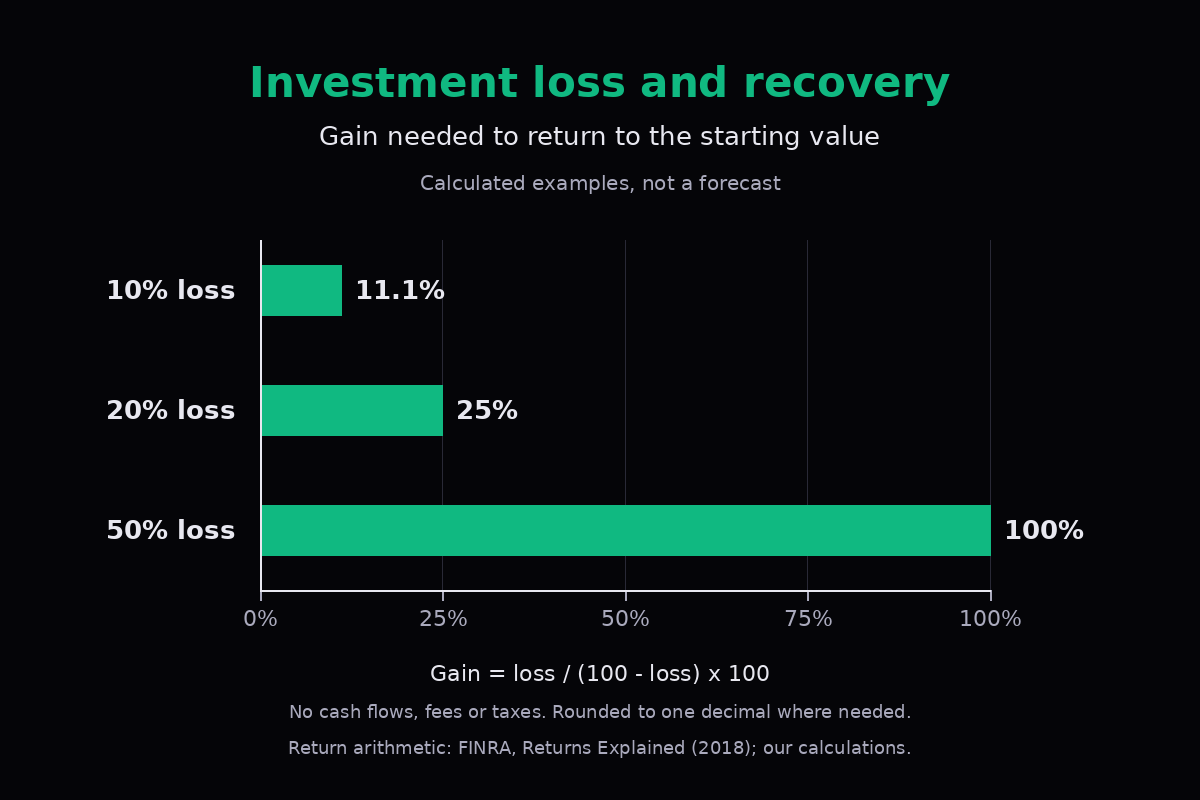
Method: remaining value = starting value × (1 − loss ÷ 100). Recovery gain (%) = loss ÷ (100 − loss) × 100. These are our calculated examples using percentage return arithmetic. FINRA explains return calculations in “How Are Your Investments Doing? Returns, Explained” (2018).
The model excludes deposits, withdrawals, income, fees, taxes, and inflation. Results show a total recovery gain, not an annual rate or a recovery date. Educational tool, not personalized financial advice.
Read the balance before the percentage
Suppose an investment starts at $10,000 and loses 20%. It now holds $8,000. A subsequent 20% gain adds $1,600, leaving $9,600. To recover the missing $2,000, the smaller balance needs a 25% gain. These figures describe a hypothetical calculation, not a forecast.
The recovery percentage does not depend on the starting amount. The amount of money at stake does. Use a realistic balance when you compare possible losses. A percentage can look abstract until you see the missing dollars beside your goal.
At a 100% loss, the balance reaches zero. No finite percentage gain on that zero balance can restore the starting investment. Adding new money changes the calculation. A larger account balance after a deposit does not, by itself, show an investment gain.
Use the result to review your portfolio
Check what you own
A portfolio is your collection of investments. Review the companies, industries, and markets behind each holding. Different fund names can still represent similar exposure. Write down the largest holdings before you assume that a long list spreads your risk.
The Financial Conduct Authority’s “Diversification” guide (updated 2025) explains why investments across different products and markets reduce dependence on one choice. Diversification can reduce risk, but it cannot remove all risk. The calculator does not measure how diversified your portfolio is.
Separate a target from a prediction
A required recovery gain tells you the mathematical hurdle. It does not tell you whether a holding will clear it. The tool has no price history, company accounts, or forecast model. It cannot select an investment or estimate its chance of recovery.
Include costs in your next check
The SEC’s “Ten Investment Tips for 2025” bulletin, published in 2024, explains that higher costs require better performance to produce the same return. FINRA’s 2018 return guide also includes investment income and costs. Use account records for an actual performance review; this simplified calculator only models a change in value.
Make the calculation useful
- Choose the balance before the loss. Keep the currency and valuation date consistent.
- Enter the loss you want to examine. Try another loss to compare the recovery requirement.
- Record both the remaining dollars and the required gain. Label the result as a scenario.
- List the assumptions you left out. Check deposits, income, withdrawals, and charges against your records.
If you use a previous account peak as your starting value, describe that choice in your notes. If you use your original purchase amount, say so. Different starting points answer different questions, even when the current balance is the same.
Keep the result beside your investment goal. The calculator gives you a clear question to investigate: what would need to happen for this balance to recover? It does not promise that the recovery will happen.